02 // Requirements for Single-Particle Control
FIVE ENGINEERING PREREQUISITES — SUBSTRATE, ADDRESSING, FREQUENCY, THERMODYNAMICS, SOFTWARE
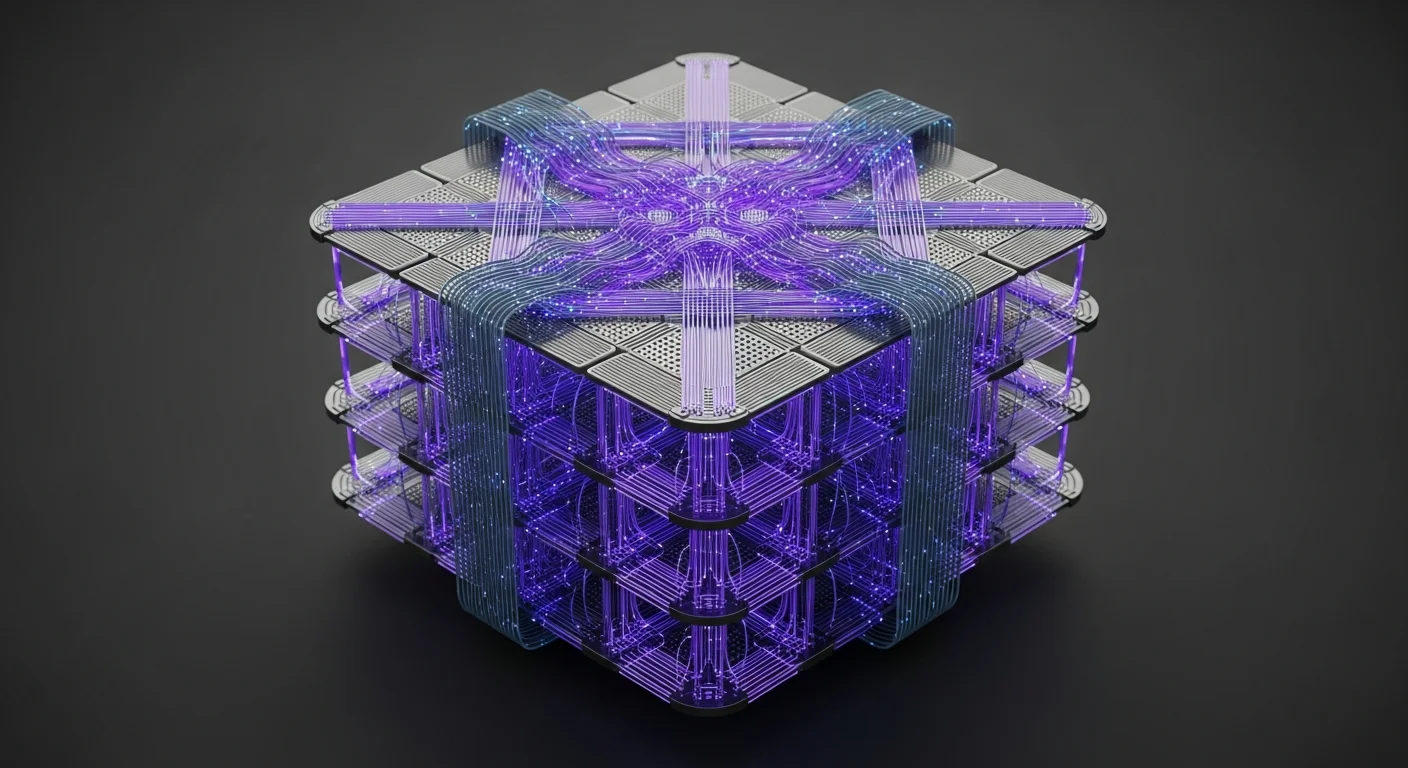
Regardless of which particle is being targeted, single-particle control imposes a common set of engineering requirements. These requirements are independent of each other — failing any one of them is sufficient to prevent particle-level operation, and meeting all of them simultaneously is the design constraint that governs every Aetheric Sciences program.
1. Substrate. The host material must not interfere with the particle being controlled. For electrons and photons at Tier 1, this means a lattice with minimal thermal vibration (high Debye temperature), no parasitic spin coupling (isotopic purity), wide optical transparency (UV through IR), and sufficient thermal conductivity to remove incidental heat without active cooling. Diamond satisfies all four constraints simultaneously. No other known material does. For higher-tier particles, the substrate requirements become more exotic — Tier 3 operations may require plasma-phase substrates or vacuum confinement rather than solid-state hosts.[6]
2. Single-Particle Addressing. The system must be able to identify and interact with one specific particle at a known location, distinct from all neighboring particles. For NV-center electrons, this is achieved by ion implantation at controlled lattice coordinates followed by optical addressing via confocal microscopy. For photons, it is achieved by waveguide routing — the photon is confined to a specific channel by total internal reflection. For higher-tier particles, addressing becomes the dominant engineering challenge: quarks are confined within hadrons and cannot be individually addressed without disrupting the confining potential.[7]
3. Frequency Access. Each particle species has characteristic energy scales that determine the electromagnetic frequencies required for initialization, manipulation, and readout. Tier 1 particles operate at optical and microwave frequencies (THz to PHz). Tier 2 and 3 particles require progressively higher frequencies, extending into X-ray and gamma regimes. The frequency ladder (Section 04) maps these requirements across the electromagnetic spectrum and identifies the Aetheric Sciences product that operates at each band.[8]
4. Reversible Thermodynamics. Single-particle operations must approach thermodynamic reversibility to avoid destroying the quantum state being controlled. Every irreversible bit erasure generates a minimum of kT ln 2 joules of entropy. At the single-particle level, this entropy is not a minor inefficiency — it is sufficient to decohere the system. Reversible logic gates (Toffoli, Fredkin, photonic beam-splitter networks) preserve information and approach zero entropy generation per logical operation.[9]
5. Software Orchestration. Single-particle control generates data at rates that exceed human interpretive bandwidth by many orders of magnitude. An NV-center array operating at MHz readout rates produces gigabytes per second of spin-state telemetry. Encoding problems into optical fields, scheduling operations across distributed nodes, and interpreting interference-pattern outputs requires autonomous software systems. The Aetheric Sciences software program (the platform, FAF) addresses this requirement.[10]