Aetheric Sciences
PARTICLE CONTROL DIVISION
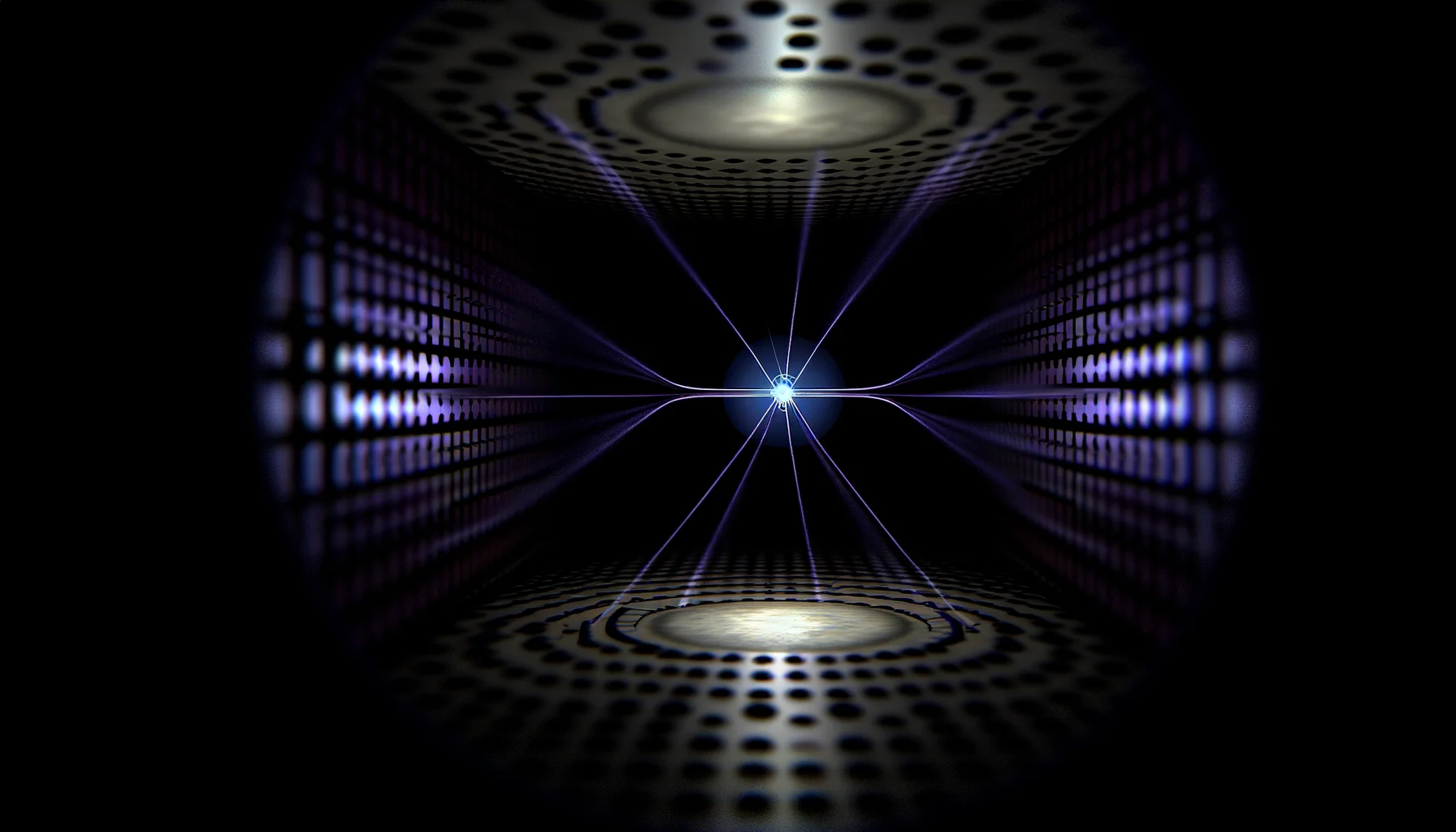
SINGLE-PARTICLE CONFINEMENT — ELECTROMAGNETIC FIELD GEOMETRY
The Standard Model of particle physics describes seventeen fundamental particles. Aetheric Sciences aims to control every one.
The Standard Model is the most experimentally validated framework in the history of physics. It catalogs every known fundamental particle: six quarks, six leptons, four gauge bosons, and the Higgs boson. These seventeen particles and their interactions account for all observed electromagnetic, weak, and strong nuclear phenomena.
It is not, however, an engineering document. The Standard Model describes what exists. It does not describe how to isolate, address, manipulate, and read out each particle individually under controlled conditions outside of a collider. That is an engineering problem. It is the engineering problem that defines Aetheric Sciences.
The division's current shipping products operate on two particle species: electrons (trapped at nitrogen-vacancy centers in diamond, addressed optically, spin-state controlled via microwave fields) and photons (routed through diamond and lithium niobate waveguides, carrying information in frequency, phase, and polarization channels).
They are also two particles out of seventeen. The remaining fifteen require progressively higher energy densities, more exotic confinement geometries, and shorter interaction timescales. The research program to reach them is measured in decades.
CONCEPTS
01 // The Standard Model as Engineering Target
Seventeen particles — four accessibility tiers
02 // Requirements for Single-Particle Control
Five engineering prerequisites for particle-level operation
03 // The Diamond Substrate
Why Carbon-12 diamond is the optimal Tier 1 host
05 // Information Thermodynamics
Landauer's principle — reversible computing — the physical cost of information
SYSTEMS
04 // The Frequency Ladder
Electromagnetic access bands — from telemetry to the Planck ceiling
06 // The Aetheric Processor
4 cm² diamond photonic die — Tier 1 shipping product
07 // The AKASHA Kernel
Energy-minimization computation on photonic substrate
08 // Product Architecture Tiers
Mote / Blade / Monolith — three scales, three horizons
09 // The Software Layer
the platform — FAF — self-optimizing orchestration
RESEARCH
10 // Cross-Division Integration
The particle program as a dependency tree across Laks Industries
11 // Research Roadmap
Three phases — from shipping product to Standard Model completion
REFERENCES
Endnotes & Bibliography
Full citation index and source material